





We now also ship with  Shipments available and to Cyprus.
Shipments available and to Cyprus.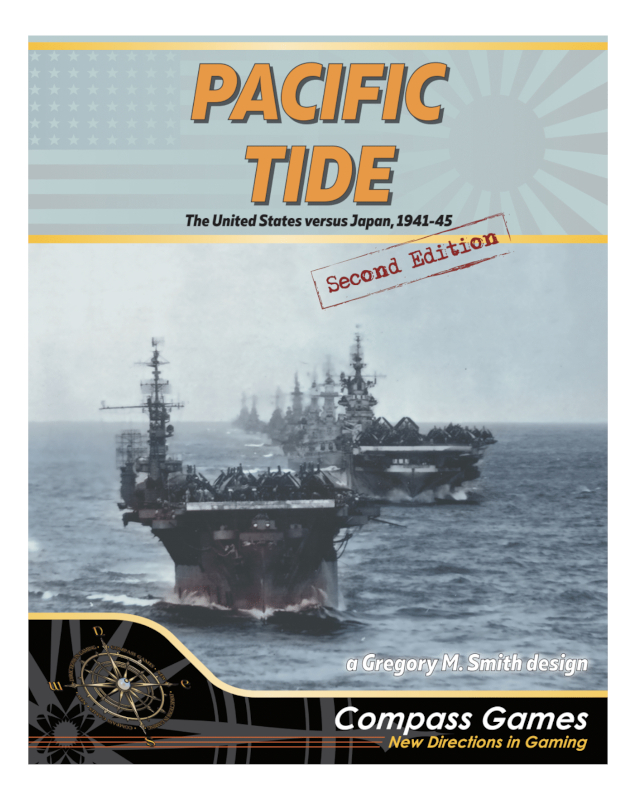


Pacific Tide: The United States versus Japan, 1941–45
An amazing strategic-level board wargame, covering the struggle between the United States (including some Commonwealth forces) and Japan in the Β’ World War by game designer Gregory M. Smith.
€70,99
Μόνο 1 απομένουν σε απόθεμα

Free gift wrapping available

Pay by cash on delivery, bank transfer, PayPal, or credit card.

Authenticity and quality guarantee
PAYMENT
You can pay using the following methods:
• Cash on delivery (for purchases up to €119.99)
• Credit card payment.
• PayPal – via credit or debit card
• Bank transfer or IRIS payment.
• Cash on delivery (for residents of Heraklion, Crete)
SHIPPING - DELIVERY COSTS
With Elta Courier (Greece)
Your order will be delivered within 3 business days anywhere in Greece. ELTA Courier delivers Monday to Friday, 09:00–18:00.
For remote and hard-to-reach areas, delivery times may be longer.
Shipping costs up to 3kg are €4, while each additional kilogram costs €1.10.
For orders over €80.00, shipping is FREE throughout Greece.
If you are a resident of Crete, your order is usually delivered on the next business day.
For residents of Heraklion, Crete, order delivery may be arranged free of charge upon request.
With Box Now (Greece - Cyprus)
- For small and medium parcels within Greece, shipping costs €4, while for Cyprus it is €10 (for small and medium parcels, not large ones).
- For large parcels within Greece, our store will contact you before shipment regarding any difference in shipping cost.
With DHL Express (for Cyprus)
DHL Express shipments are priced according to the parcel’s weight and volume. The exact shipping cost is calculated during checkout.
With DHL Economy (for the rest of Europe)
RETURNS - EXCHANGES
Any exchange request must be made within 15 days from the purchase date. It must be accompanied by the purchase receipt so that we can assist you quickly and reliably.
They shopped at Meeple Planet and shared their thoughts on our service
More Google reviews
Pacific Tide: The United States versus Japan, 1941–45
Pacific Tide: The United States versus Japan, 1941-45 is a strategic-level board wargame that covers the struggle between the United States (including some Commonwealth forces) and Japan in the Β’ World War by game designer Gregory M. Smith. This game uses a unique and fast, card-based, battle/construction system that revolves around carrier operations and gives players a host of decisions. Although highly competitive as a two-player game, Pacific Tide can be enjoyed again and again in solitaire form with the unique, “personality” bot system.
Despite the strategic level of the game, there are operational and even tactical nuances, as players must decide when and how to commit carrier forces, land-based air forces, and even their intelligence assets. To some extent, the Japanese player is fighting against time. The quality of his pilots degrades over time, and starting in 1943, he also loses the strategic initiative as he becomes the second player. The American player also struggles with time, as he cannot sit idly by and adopt a lax approach to defeat Japan. If he doesn’t win by 1945, he doesn’t win at all. The tension increases as both sides race toward decisive carrier battles and the capture of key geographic objectives.
The card-based battle/build system is a different version of the “normal” systems that are based on event/operation points. Separate card decks are provided for the American and the Japanese player. Each year, players receive that year’s cards for free… but must use build points to buy older cards. This will cause some agonizing moments for the player, as they usually cannot afford to re-buy every card they need (or think they need). Players must also decide which aspect of the cards to use – many have multiple but mutually exclusive uses (for example, “Do A or do B”) and those uses sometimes give very different results based on the operational or strategic needs at the time. To ensure an intense and dynamic game, the system forces players to make many choices and decisions during the game.
Units include five different types:
– CV units represent individual aircraft carriers or small groups of escort carriers.
– INF units represent all types of land combat troops, including Marine and Army units.
– Naval aviation units represent carrier-based aircraft
– Land air units represent bombers and fighters based on land.
– Partisan units represent the Philippine resistance, which grew to significant size by the end of the war.
– The codes for organizing the campaign and reinforcement are printed on the bench.
– Improved ergonomics on the installation and reinforcement panels
Control and fortification markers are also provided for the game.
Special rules are provided for amphibious assaults, fleet repairs, the effects of resupply and partisans. The bidding rules determine which side one will play in a tournament-style game format.
As a bonus for solo players, Pacific Tide features a solitaire assistant – commonly known as “Bot” – which provides guidance to the player for either side during solitaire. The assistant acts differently depending on the “personality” assigned to it… aggressive, defensive or balanced. All of the game's cards have a rating which the assistants will prioritize differently for play. Although highly competitive as a two-player game, Pacific Tide can be enjoyed again and again in solitaire format with the unique, “personality” Bot system.
See all wargames here
| Weight | 1,124 kg |
|---|---|
| Number of Players | |
| Game Duration | |
| Age | |
| Publisher | Banana games, Compass Games |
| Availability |
Features
Wargame
Number of Players : 1-2
Average Game Duration : 120’-240’
Age: 16+
Designer : Gregory M. Smith
Illustration : Ilya Kudriashov, Brien J. Miller
Publisher: Compass Games, Banana games
Category: Aviation / Flight, Nautical, Wargame, World War II
Mechanism : Area Movement, Campaign / Battle Card Driven, Dice Rolling, Events, Movement Points, Point to Point Movement, Simulation, Solo / Solitaire Game
Difficulty : 2,2 / 5
Rules Language: English
Language Dependence: High
Weight:
Only logged in customers who have purchased this product may leave a review.
Μπορεί να σας αρέσει






-5%







Reviews
There are no reviews yet.